
Patient Education
What Causes a Pollybeak Deformity—And Can It Be Fixed?
Dealing with a Pollybeak deformity after rhinoplasty? Learn what causes this common complication — from scar tissue to implant issues — and how expert revision techniques at Kowon Plastic Surgery in Seoul can restore natural nasal balance, safely and permanently.
Article
Published by Kowon Plastic Surgery, Gangnam, Seoul
-009c973c-06a0-4e78-81c4-b146276eff67.jpg)
A surgeon’s perspective on one of the most common — and frustrating — rhinoplasty complications.
At first, everything looked fine. But months after your rhinoplasty, something changed. Your nose began to develop a rounded fullness just above the tip — a shape that some describe as resembling a parrot’s beak.
If this sounds familiar, you may be dealing with what's known as a Pollybeak deformity — a common complication after nasal surgery.
At Kowon Plastic Surgery in Seoul, we’ve helped hundreds of patients from Korea and abroad correct this issue, especially after implant-based or revision rhinoplasty. It’s a frustrating experience, but one that can be addressed — safely and naturally.
Let’s explore what causes Pollybeak deformity, why it happens even with skilled surgeons, and how Dr. Kim Hyung Taek approaches repair using advanced, implant-free techniques.
What Is a Pollybeak Deformity?
A Pollybeak deformity (also called supratip fullness) occurs when the area just above the nasal tip (the supratip) projects more than the tip itself. This creates a curved, parrot-like profile — hence the name.
It can:
Make the nose appear droopy or heavy
Obscure the definition of the tip
Disrupt natural nasal lines and harmony
Create a sense of imbalance or “surgical” look
The deformity can occur early (within months) or late (even years later), especially after revision surgery or if synthetic materials were used.
What Causes Pollybeak Deformity?
There’s no single cause. Pollybeak is the result of structural imbalance — and several factors can contribute.
1. Excess Scar Tissue (Soft-Tissue Pollybeak)
The most common cause, especially in thick-skinned patients. After surgery, the body forms scar tissue to heal. But in some cases, the supratip area overproduces this tissue, leading to fullness.
More likely in patients with sebaceous or thick nasal skin
Can worsen with improper taping or massage
Often not visible until 3–6 months post-op
2. Cartilage Collapse (Structural Pollybeak)
If too much cartilage is removed from the bridge or septum — particularly in the lower third of the nose — the tip can lose support. As the soft tissue settles, the supratip sags forward.
Common in aggressive dorsal hump removal
Can result from poor tip projection or under-rotation
Often seen in implant-based surgeries where cartilage support was compromised
“The nose is like an architectural bridge. Remove too much support, and the structure buckles. Pollybeak is often a collapse, not just swelling.” – Dr. Kim Hyung Taek
3. Implant Problems or Silicone Migration
In some primary surgeries (especially outside Korea), silicone implants are placed over the bridge. Over time, these implants can shift downward, pushing on the supratip and mimicking Pollybeak.
Common in over-projected silicone implants
Can occur due to infection, trauma, or capsular contracture
4. Inadequate Tip Projection or Rotation
Even if the supratip is normal, if the tip itself is weak or drooping, the profile will still look curved. This visual imbalance can simulate Pollybeak.
Seen in under-corrected tips or in ethnic rhinoplasty cases where natural tip projection is minimal
Can Pollybeak Be Prevented?
To some extent — yes. A well-executed rhinoplasty with careful planning can minimize the risk.
At Kowon Plastic Surgery, prevention starts with:
Preserving and reinforcing cartilage, not removing excessively
Avoiding synthetic implants that can shift or press on soft tissue
Using rib cartilage grafts for strong, long-lasting structural support
Understanding skin thickness and planning for scar tissue behavior
Monitoring healing with detailed follow-ups and taping techniques
But even with the best technique, some patients are biologically prone to soft tissue thickening. That’s why early detection and proper aftercare matter.
How Do We Fix a Pollybeak Deformity?

First: Determine the Type
There’s no one-size-fits-all solution. We must identify:
Is the fullness due to scar tissue, cartilage collapse, or implant issues?
Is the skin thick, or is the tip under-projected?
Has the patient had prior surgeries, and what materials were used?
Only then can we plan a correction strategy.
1. For Scar Tissue Pollybeak (Soft-Tissue Type)
In mild cases, we start with non-surgical treatments:
Steroid injections to reduce scar buildup
Taping techniques to compress the supratip during healing
Careful observation over 3–6 months
If the fullness persists after 12+ months, surgical debulking of the scar tissue may be performed. This is a subtle, delicate procedure — best done by an experienced revision specialist.
2. For Structural Pollybeak (Cartilage-Related)
This requires open revision rhinoplasty. Dr. Kim uses a precision-based approach to:
Reinforce the tip with cartilage grafts (usually from the rib or ear)
Restore septal support if the dorsal structure has collapsed
Reshape the supratip contour by adjusting soft tissue and adding subtle grafts
No synthetic implants are used. Instead, we rebuild the architecture naturally, allowing the nose to maintain shape over time — without shifting or foreign body risks.
“When rebuilding a Pollybeak nose, the goal is not just to remove fullness — it’s to restore balance. That often means enhancing the tip, not just reducing the bridge.” – Dr. Kim
3. For Implant-Induced Pollybeak
If a silicone implant has migrated or is pressing on the supratip:
The implant must be completely removed
The bridge is reconstructed using the patient’s own cartilage
Special care is taken to prevent collapse, especially in thinner-skinned patients
This type of revision is more complex, but also more rewarding, as the patient can finally achieve a soft, natural-looking nose that ages well.
Realistic Expectations: What You Should Know Before Correction
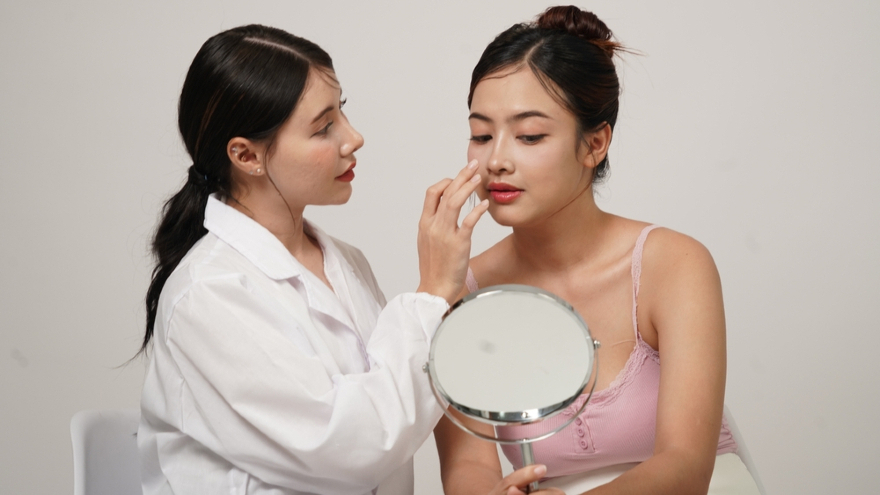
Correcting a Pollybeak deformity is a nuanced revision surgery — not a quick fix.
Here’s what we tell our patients at Kowon:
Wait at least 9–12 months after your last surgery before considering revision, unless there’s clear implant migration or functional issues.
Healing may take up to a year after revision, especially with rib cartilage grafts.
The results depend heavily on skin thickness, scar behavior, and how the original surgery was done.
Choose a surgeon who has experience in both primary and revision rhinoplasty — and especially in implant-free techniques.
Dr. Kim’s Approach: Why Implant-Free Matters
Many Pollybeak cases we see involve previous implant use — usually silicone — that pushed the soft tissue outward or caused loss of nasal support.
At Kowon Plastic Surgery, we believe in building noses that last — not ones that need constant corrections.
“Implants can’t adapt to your body. Cartilage can. That’s why we focus on rib cartilage rhinoplasty — especially for patients with prior complications like Pollybeak.” – Dr. Kim
With over 10,000 surgeries and two decades of experience, Dr. Kim has developed advanced techniques to reshape rib cartilage into elegant, supportive grafts — allowing even complex revision patients to regain confidence.
The Bottom Line: Can Pollybeak Be Fixed?
Yes — but it depends on the cause, timing, and surgical skill.
With the right diagnosis and a tailored revision plan, most Pollybeak deformities can be corrected — often with dramatic improvement in both profile and function.
Whether it's scar tissue, structural imbalance, or implant-related, Kowon Plastic Surgery offers personalized solutions grounded in safety, precision, and natural aesthetics.
Considering a Correction?
If your nose has developed supratip fullness after surgery — especially if you had an implant or multiple procedures — don’t guess your way through it.
📍Consult a clinic that specializes in implant-free, high-safety revision rhinoplasty — like Kowon Plastic Surgery in Gangnam, Seoul.
Medical Information
Read this article as general guidance.
- This article is provided for general education. It does not replace an in-person examination by a qualified surgeon.
- Results vary between patients. Rhinoplasty can involve bleeding, infection, scarring, asymmetry, breathing changes, graft or implant problems and the possibility of revision surgery.
- Computer simulations and before-and-after photographs cannot guarantee an individual outcome.
- Any prices or timelines mentioned are general. Request an individualised, itemised written quotation and a procedure-specific recovery schedule before paying a deposit or booking travel.
Published by
Kowon Plastic Surgery
A rhinoplasty-focused clinic in Gangnam, Seoul, led by Dr. Kim Hyeongtaek and registered with Medical Korea to treat international patients.
Consultation
Questions about this topic? Ask Dr. Kim directly.
2F, 110 Dosan-daero, Gangnam-gu, Seoul 06038. Send clear photographs, your main concerns and any previous surgery history, and Dr. Kim Hyeongtaek will review what can be assessed before you travel.
International Patient Desk — Gangnam
Kowon Plastic Surgery
Director Dr. Kim Hyeongtaek
Single-surgeon rhinoplasty and autologous cartilage center in Seoul. Delivering meticulous, individual surgical architecture for primary and complex revision procedures.
Practice & Inquiries
Gangnam Clinic
2F, 110 Dosan-daero, Gangnam District, Seoul 06038, South Korea
Consultation Hours (KST)
Mon – Fri: 10:00 – 19:00
Sat: 10:00 – 16:00 · Sun & Holidays Closed
Direct Communication Channels
Telephone: +822-6242-7080WhatsApp: +1-206-809-1367LINE Official: @967xxmreWeChat Consultation Service© 2025 Kowon Plastic Surgery. All rights reserved.
Registered Medical Institution for Foreign Patient Facilitation (Medical Korea). Surgical consultation and procedure terms subject to Korean Ministry of Health and Welfare guidelines.