
Patient Education
How Nose Jobs Are Evolving in Male Aesthetics
Discover how male rhinoplasty is evolving toward natural, functional results. Learn why more men are choosing implant-free techniques like rib cartilage grafts at expert clinics like Kowon Plastic Surgery in Seoul.
Article
Published by Kowon Plastic Surgery, Gangnam, Seoul

Why modern male rhinoplasty is no longer about perfection — but presence.
“I don’t want it to look ‘done.’ I just want to breathe better and look more like myself.”
This is something we hear more often from male patients today. At Kowon Plastic Surgery, it’s clear that male aesthetics are undergoing a quiet but powerful transformation — and rhinoplasty is at the center of it.
Gone are the days when cosmetic nose surgery for men was a taboo topic, let alone a one-size-fits-all procedure. Today, male patients are more informed, more intentional, and more focused on natural balance than ever before. They’re not chasing trends. They’re seeking refinement — and often, functional relief.
In this article, we explore how male rhinoplasty is evolving, what makes it different from female rhinoplasty, and why modern techniques — like implant-free surgery using rib cartilage — are shaping the future for men seeking subtle, strong, and safe results.
The New Male Aesthetic: Less About Ideal, More About Identity
If you scroll through most social media feeds, you’ll notice a growing presence of men discussing their rhinoplasty journeys — often with strikingly subtle results. What many are after is not a dramatic transformation, but something more nuanced:
✅ A nose that feels proportionate to their face
✅ A profile that looks strong, not sculpted
✅ Breathing that finally feels effortless
In Korea — the epicenter of global aesthetic trends — this shift is particularly evident. While women often seek refinement and harmony, men tend to focus on structure, function, and authenticity.
“For male patients, we’re not chasing symmetry or slimness. We’re reinforcing character,” says Dr. Kim Hyung Taek, director of Kowon Plastic Surgery and a global leader in natural, implant-free rhinoplasty.
This shift in male aesthetics is not about softening features. It’s about preserving masculinity while correcting structural issues — and doing so in a way that doesn’t announce itself as surgery.
What Makes Male Rhinoplasty Different?
Male and female noses differ anatomically, structurally, and aesthetically. These differences must be deeply understood — not just at a textbook level, but at a surgical level — to deliver safe, satisfying results.
1. Stronger Bone Structure, Thicker Skin
Men typically have thicker nasal skin, which can be more challenging when refining the tip or narrowing the bridge. There’s less room for error, and more demand on precise grafting or cartilage support.
2. More Prominent Dorsal Humps
Many male patients come in with prominent humps or deviated septums. While women often want a smooth slope, men usually prefer a straighter or stronger profile — with just enough refinement to feel confident, not artificial.
3. Functional Demands Are Higher
Sports injuries, past trauma, or chronic breathing issues often drive male patients toward surgery. That’s why function-preserving or function-restoring rhinoplasty is critical. At Kowon, every aesthetic change is paired with internal correction — whether that’s septoplasty, turbinate reduction, or valve repair.
Why Implant-Free Rhinoplasty Is Gaining Popularity Among Men
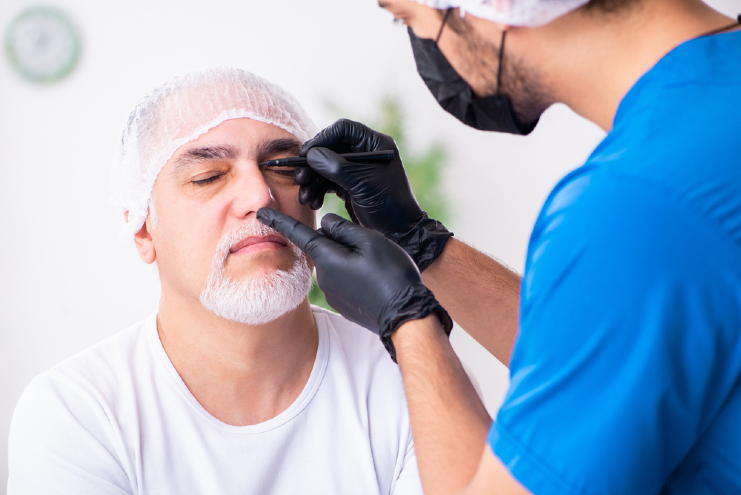
One of the biggest evolutions in male rhinoplasty? A growing preference for implant-free, autologous (self-tissue) techniques — particularly using rib cartilage.
The Problem With Silicone in Male Noses
Silicone or synthetic implants were once the standard in Asia, especially for creating higher bridges. But for men — especially those with thicker skin, active lifestyles, or past trauma — implants often lead to long-term complications:
Shifting or extrusion over time
Visible edges under thicker skin
Infection risks, especially post-injury
A rigid, artificial look in the profile
Dr. Kim has seen these complications firsthand in countless revision cases. “The nose isn’t just for appearance — it’s a living, breathing structure. Implants don’t adapt to that reality.”
Why Rib Cartilage Works Better
Rib cartilage offers several key advantages in male rhinoplasty:
Structural strength to support thick skin
Flexibility in shaping the bridge and tip naturally
No risk of foreign body rejection
Long-term stability, especially for patients who have had previous trauma or surgery
At Kowon Plastic Surgery, Dr. Kim specializes in using carefully sculpted rib cartilage — not just harvested, but artistically reshaped — to recreate the nasal structure from the inside out. For male patients, this results in subtle enhancement with maximum function and durability.
Revision Rhinoplasty in Men: A Growing Subspecialty
Another sign of evolution? The rising number of male patients seeking revision rhinoplasty — often after unsatisfactory or overly aggressive first surgeries.
Common Issues We See in Male Revision Cases:
Over-resected bridges that look too narrow or unnatural
Collapsed tips that create a drooping or pinched appearance
Persistent breathing problems that were never addressed in the initial surgery
Visible or extruding implants from thin coverage or trauma
Many of these cases require advanced reconstruction — often using rib cartilage to rebuild support, restore breathing, and realign aesthetics.
Dr. Kim approaches these surgeries with a conservative, personalized plan. “You don’t fix a previous nose job by doing more. You fix it by restoring structure and working with what’s left.”
International Patients: Why Men Are Traveling to Korea for Nose Surgery
Korea has long been the global destination for facial aesthetics, but male patients are now joining that wave — especially for advanced rhinoplasty techniques. At Kowon, we’ve welcomed male patients from the U.S., Australia, the Middle East, and across Asia, often for one key reason: trust in expertise.
They’re not looking for a cookie-cutter ‘Korean nose.’
They’re looking for a surgeon who understands male anatomy, function, and aesthetics — and who can restore both confidence and comfort.
A Closer Look at a Male Case (Fictionalized for Privacy)
-1546ad2a-7cc2-4c70-b599-bb6f103da2cb.jpg)
Patient: 34-year-old male, previous rhinoplasty in his 20s using silicone implant
Concerns: Visible implant outline, nasal stiffness, occasional breathing issues
Approach: Removal of silicone implant, reconstruction using rib cartilage grafts, internal correction for nasal valve collapse
Outcome: Stronger profile, improved breathing, natural nasal mobility
“I was worried revision would make things worse,” he shared post-op. “But now, I look like myself — just better. And I can finally breathe.”
Final Takeaway: What Modern Male Rhinoplasty Is Really About
Modern male rhinoplasty isn’t about making you look different. It’s about making you feel more like yourself — stronger, more balanced, and free to breathe without distraction.
At Kowon Plastic Surgery, we believe in precision without pretense. Every male nose we work on is treated with the same level of care, whether it’s your first surgery or your third.
We don’t rush. We don’t generalize. And we don’t follow trends.
We focus on building noses that work well, age well, and look right in real life — not just in photos.
Considering Nose Surgery? Here's What to Look For:
A surgeon who specializes in both aesthetic and functional rhinoplasty
A clinic with experience in male-specific anatomy and revision cases
A safety-first approach that prioritizes natural materials like rib cartilage
Personalized surgical planning — not a volume-based, factory-style clinic
If you’re considering rhinoplasty — especially implant-free or revision work — consult a clinic with proven expertise in male aesthetics and functional correction.
That’s what Kowon Plastic Surgery is known for.
Medical Information
Read this article as general guidance.
- This article is provided for general education. It does not replace an in-person examination by a qualified surgeon.
- Results vary between patients. Rhinoplasty can involve bleeding, infection, scarring, asymmetry, breathing changes, graft or implant problems and the possibility of revision surgery.
- Computer simulations and before-and-after photographs cannot guarantee an individual outcome.
- Any prices or timelines mentioned are general. Request an individualised, itemised written quotation and a procedure-specific recovery schedule before paying a deposit or booking travel.
Published by
Kowon Plastic Surgery
A rhinoplasty-focused clinic in Gangnam, Seoul, led by Dr. Kim Hyeongtaek and registered with Medical Korea to treat international patients.
Consultation
Questions about this topic? Ask Dr. Kim directly.
2F, 110 Dosan-daero, Gangnam-gu, Seoul 06038. Send clear photographs, your main concerns and any previous surgery history, and Dr. Kim Hyeongtaek will review what can be assessed before you travel.
International Patient Desk — Gangnam
Kowon Plastic Surgery
Director Dr. Kim Hyeongtaek
Single-surgeon rhinoplasty and autologous cartilage center in Seoul. Delivering meticulous, individual surgical architecture for primary and complex revision procedures.
Practice & Inquiries
Gangnam Clinic
2F, 110 Dosan-daero, Gangnam District, Seoul 06038, South Korea
Consultation Hours (KST)
Mon – Fri: 10:00 – 19:00
Sat: 10:00 – 16:00 · Sun & Holidays Closed
Direct Communication Channels
Telephone: +822-6242-7080WhatsApp: +1-206-809-1367LINE Official: @967xxmreWeChat Consultation Service© 2025 Kowon Plastic Surgery. All rights reserved.
Registered Medical Institution for Foreign Patient Facilitation (Medical Korea). Surgical consultation and procedure terms subject to Korean Ministry of Health and Welfare guidelines.