
Patient Education
How Long Does Swelling Really Last After Nose Surgery?
Wondering how long swelling lasts after nose surgery? Learn the real recovery timeline from expert rhinoplasty surgeons at Kowon — including tips for safe, natural healing.
Article
Published by Kowon Plastic Surgery, Gangnam, Seoul
If you’ve recently had rhinoplasty — or you’re thinking about it — you’re probably wondering:
“How long will I look swollen?”
“When will my final results show?”
And maybe most honestly:
“How long until I feel like myself again?”
At Kowon Plastic Surgery in Seoul, we hear these questions daily — not just from local patients, but from those flying in from around the world for precision, high-safety rhinoplasty. Whether you’ve had primary surgery, a revision, or implant removal, swelling is part of the healing journey.
But here’s the truth: not all swelling is the same, and neither is the recovery timeline.
Let’s break it down — what causes swelling, how long it truly lasts, and what you can expect week by week as your new nose takes shape.
The Short Answer:
Most visible swelling improves within 2–4 weeks, but final refinement takes 6–12 months — or even longer for complex revision cases.
That doesn’t mean you’ll look “swollen” for a year — far from it.
But subtle internal changes, tip definition, and skin contraction evolve over time.
Think of rhinoplasty swelling like a slow-fading watercolor — the boldest lines disappear early, but the fine detail takes patience.
Why Swelling Happens After Rhinoplasty
Swelling is your body’s natural response to surgical change. During rhinoplasty, the nasal skin is lifted, the bone and cartilage are reshaped, and (in many cases) grafts are placed to support or refine the structure. This careful internal work triggers:
Inflammation as part of the healing process
Fluid retention around the surgical site
Lymphatic slow-down due to disrupted drainage pathways
Skin adaptation as it re-drapes over a new nasal frame
The tip and columella (area under the tip) are usually the last to de-swell, especially if the skin is thick or if rib cartilage was used — a common method here at Kowon for stable, implant-free results.
The Real Timeline: Swelling After Nose Surgery
Here’s a realistic, week-by-week look at how swelling evolves — based on thousands of cases we’ve treated at Kowon Plastic Surgery:
Week 1: The Puffy Phase
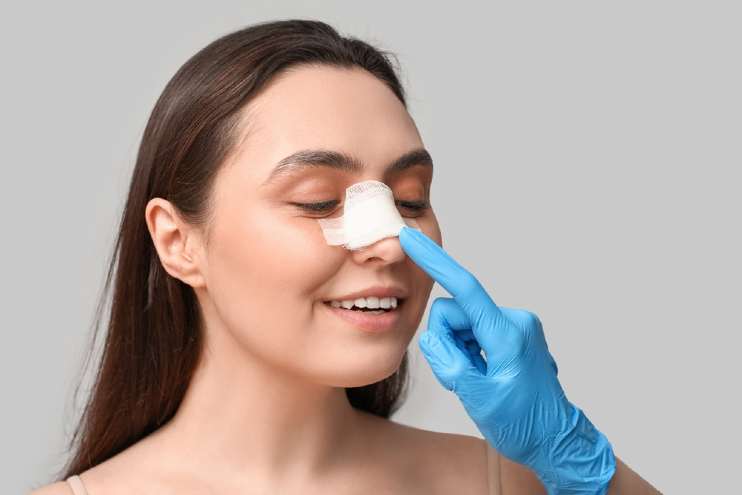
You’ll have a splint on your nose and possibly tape or internal supports.
Eyes, cheeks, and nose bridge may feel swollen or bruised.
Most patients don’t feel pain — just tightness and congestion.
Your nose will look wider and rounder than expected. This is normal.
Dr. Kim’s note:
“Don’t judge your results yet. This phase is all about protection, not appearance.”
Week 2–3: Swelling Drops — But Not Gone
The external splint is removed around Day 7–10.
You’ll see your new nasal shape, but it may still appear “stubby” or “inflated,” especially at the tip.
Mild swelling may fluctuate day to day.
👉 Most patients feel camera-ready (with makeup) by the 3rd week.
1–3 Months: Subtle Contours Emerge
Around 60–70% of the swelling has resolved.
The bridge appears more refined, and tip projection starts to stabilize.
Skin begins to contract and conform to the underlying structure.
Pro tip: Swelling can be asymmetric — one side of the tip may look more puffy for a few weeks. This balances out.
3–6 Months: Natural Look Begins to Settle
Nasal tip swelling slowly fades, especially in thick skin types.
Breathing improves as internal swelling (e.g., turbinates, septum) reduces.
In natural light or on camera, the nose now appears “settled” to most observers.
At Kowon, this is when many patients begin to forget they had surgery — and simply enjoy the result.
6–12 Months (and beyond): Final Refinement
Final details like tip definition, nostril symmetry, and scar softening occur.
For revision rhinoplasty or rib cartilage reconstruction, this stage can extend to 12–18 months.
Your “final nose” is now visible — natural, functional, and stable.
Factors That Affect Swelling Duration
No two noses are the same — and neither are recoveries. Here's what can influence swelling length:
Factor | Effect on Swelling |
|---|---|
Surgical technique | Less-traumatic techniques = faster resolution |
Use of implants vs rib cartilage | Rib cartilage swelling lasts longer, but heals more safely |
Skin thickness | Thick skin holds swelling longer (esp. at the tip) |
Revision surgery | Longer swelling due to scar tissue and structural correction |
Post-op care | Elevation, taping, and anti-inflammatories help reduce duration |
What You Can Do to Reduce Swelling (Safely)

While some swelling is unavoidable, you can support your body’s healing:
✅ Elevate your head (even during sleep)
Gravity helps drain fluid faster.
✅ Follow your surgeon’s taping protocol
At Kowon, we often recommend nasal taping for 2–3 weeks post-op to control tip swelling.
✅ Minimize salty foods and alcohol
Both can cause fluid retention and puffiness.
✅ Avoid overexertion or hot environments early on
Heavy workouts or saunas can worsen internal swelling.
✅ Trust the timeline
Most regrets or revisions happen because of premature judgment. Healing takes time — let your nose mature before deciding how you feel about it.
Why Patience Pays Off — Especially for Natural Rhinoplasty
At Kowon Plastic Surgery, we specialize in implant-free, rib cartilage-based rhinoplasty — known for its natural aesthetic and high safety profile. But because we rely on your own tissue (not synthetic implants), the healing process is more biologically authentic — and yes, sometimes slower.
But here’s what we tell every patient:
“Quick results often fade. Natural results that last? Those take time.”
The swelling you experience is your body responding to precision changes — not trauma. And when guided by a careful, no-shortcut approach, the results are worth waiting for.
Still Swollen After 6 Months? Here’s When to Check In

Mild puffiness at the tip or bridge can linger for months — especially in thicker skin types or revision cases. But if you notice:
Hard lumps under the skin
Significant asymmetry that hasn’t improved
A return of breathing issues
Excess redness or pain
…it’s time to speak with your surgeon.
At Kowon, we provide long-term follow-up care for all patients — because true healing isn’t rushed, and questions deserve answers.
Final Takeaway:
Swelling after rhinoplasty is temporary. But the choices you make during surgery last much longer.
If you want a nose that looks better and breathes better — and you're willing to invest in healing the right way — choose a clinic that prioritizes structural integrity and individualized care.
At Kowon Plastic Surgery, we don’t chase trends. We build noses that last.
Considering revision or implant removal?
Even if your previous surgery was years ago, swelling could be hiding issues that need deeper evaluation. Consult with a surgeon who specializes in natural, safe, and functional rhinoplasty — like Dr. Kim at Kowon.
Because a good nose is one that feels as good as it looks.
Medical Information
Read this article as general guidance.
- This article is provided for general education. It does not replace an in-person examination by a qualified surgeon.
- Results vary between patients. Rhinoplasty can involve bleeding, infection, scarring, asymmetry, breathing changes, graft or implant problems and the possibility of revision surgery.
- Computer simulations and before-and-after photographs cannot guarantee an individual outcome.
- Any prices or timelines mentioned are general. Request an individualised, itemised written quotation and a procedure-specific recovery schedule before paying a deposit or booking travel.
Published by
Kowon Plastic Surgery
A rhinoplasty-focused clinic in Gangnam, Seoul, led by Dr. Kim Hyeongtaek and registered with Medical Korea to treat international patients.
Consultation
Questions about this topic? Ask Dr. Kim directly.
2F, 110 Dosan-daero, Gangnam-gu, Seoul 06038. Send clear photographs, your main concerns and any previous surgery history, and Dr. Kim Hyeongtaek will review what can be assessed before you travel.
International Patient Desk — Gangnam
Kowon Plastic Surgery
Director Dr. Kim Hyeongtaek
Single-surgeon rhinoplasty and autologous cartilage center in Seoul. Delivering meticulous, individual surgical architecture for primary and complex revision procedures.
Practice & Inquiries
Gangnam Clinic
2F, 110 Dosan-daero, Gangnam District, Seoul 06038, South Korea
Consultation Hours (KST)
Mon – Fri: 10:00 – 19:00
Sat: 10:00 – 16:00 · Sun & Holidays Closed
Direct Communication Channels
Telephone: +822-6242-7080WhatsApp: +1-206-809-1367LINE Official: @967xxmreWeChat Consultation Service© 2025 Kowon Plastic Surgery. All rights reserved.
Registered Medical Institution for Foreign Patient Facilitation (Medical Korea). Surgical consultation and procedure terms subject to Korean Ministry of Health and Welfare guidelines.